


Rockshift Inc
Makani Games
Rockshift Inc. is the kind of arcade game I can open for a short break and understand almost immediately. I arrive at a mining operation, send machines into the ground, collect ore, improve the equipment, and gradually make the business feel more capable. That basic loop is easy to grasp, but the appeal is not only in watching numbers rise. The game works best when its visual identity, industrial setting, and steady rhythm make each small upgrade feel like part of a larger operation.
Developed by Makani Games, this free game is aimed at Everyone and runs on Android devices using version 7.0 or later. It has already built a solid audience, with more than one hundred thousand installs and an average score of 4.6 from roughly seven thousand ratings. Those figures suggest that the straightforward mining formula is connecting with players, although they do not remove the need to decide whether this particular pace suits you.
A mining game that makes its first minutes easy to read
My first impression was that Rockshift Inc. does not waste time explaining its central idea. The setting tells me what to do: extract valuable material, improve the machinery, and expand the operation. That clarity matters in an arcade game, especially when I am playing with one hand or only have a few minutes available. I do not need to learn a complicated control scheme before the first useful action.
The opening loop is also a good test of whether the game matches your habits. If you enjoy visible progress and small decisions, the early mining activity feels inviting. I can make an improvement, watch the operation become more productive, and then decide whether to keep building the same area or work toward a broader expansion. The pleasure comes from turning a modest site into something that feels organized and increasingly self-sufficient.
At the same time, this is not an arcade game built around fast reflexes in the traditional sense. The excitement is less about dodging hazards at high speed and more about maintaining momentum. Players who expect constant action, precise timing, or a level-based challenge may find the opening gentler than expected. Rockshift Inc. is closer to a compact management loop wrapped in arcade presentation than to a twitch-focused mining adventure.
Related News






That distinction helped me decide when to play it. It fits a commute, a waiting room, or a short evening session when I want progress without committing to a long quest. I can return after a pause and quickly remember the current goal. For a friend who likes games that reward a few minutes of attention at a time, I would explain the appeal as “one more upgrade” rather than “one more difficult level.”
The free entry point is useful because it lets you judge that rhythm without paying first. However, the game includes optional purchases ranging from $1.49 to $79.99 per item. I would treat that range as a reason to set a personal spending limit before getting deeply invested. The core attraction is the mining loop, so I recommend deciding whether the free experience feels satisfying before considering any purchase.
The setting communicates more than the tutorial
The strongest part of the presentation is the way the mining setting gives every action a natural purpose. A machine is not just an abstract upgrade button; it belongs to the operation. Ore is not merely a reward counter; it represents the material that keeps the business moving. Expansion feels more coherent because the game frames progress as the growth of a company rather than a disconnected sequence of arcade tasks.
Gallery
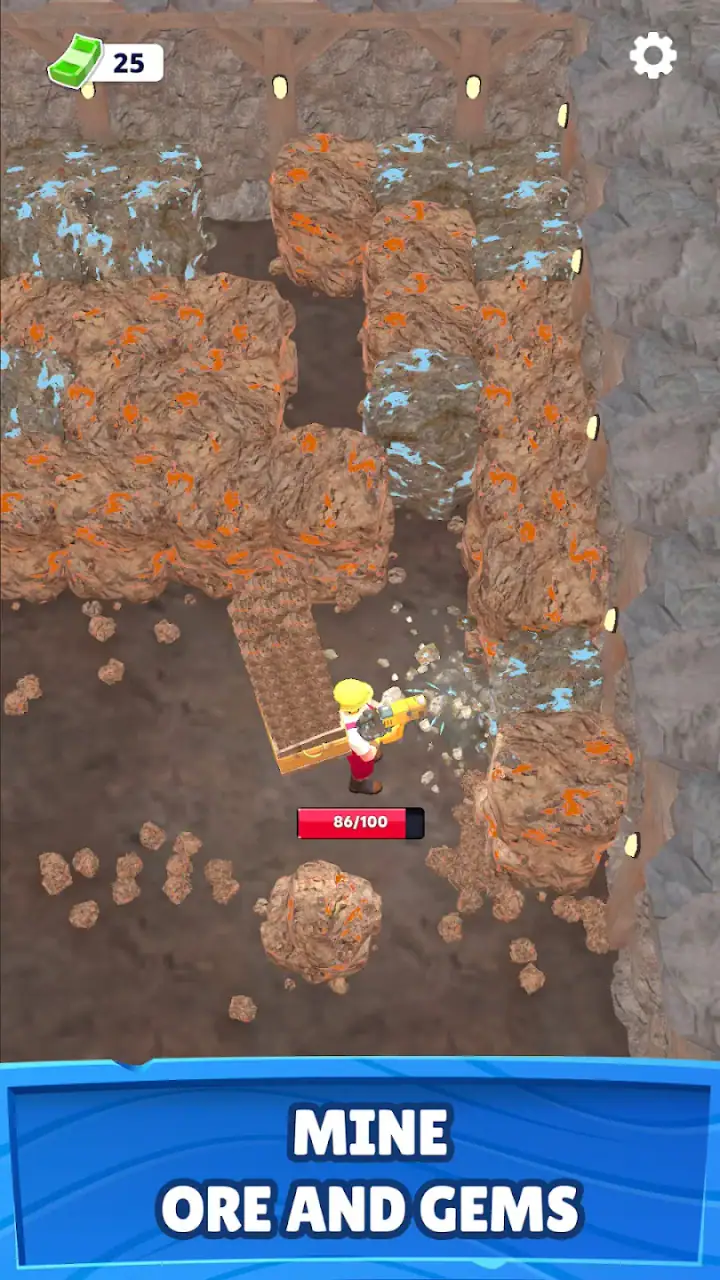
I found that this framing changes how I read small improvements. A faster or more capable machine is satisfying because it solves a visible operational problem. When the site begins to feel more productive, the improvement has a practical meaning inside the world. That is a subtle advantage over many casual arcade games, where upgrades can feel like arbitrary boosts attached to a menu.
The art direction also benefits from staying close to its industrial idea. Rock, machinery, excavation, and business growth create a consistent visual language. Even without needing a complicated story, the game has a reason for its colors, objects, and progression. The setting does not feel pasted onto a generic score-chasing system; it gives the loop a place to belong.
That coherence is especially useful for returning players. If I stop playing and come back later, the mining operation itself helps me reconstruct what I was doing. I am not relying only on a row of icons or a number at the top of the screen. The site, the machinery, and the sense of expansion provide a visual reminder of the current state of the business.
One practical tip is to pause before spending resources on the most obvious improvement. I get more value from first asking what is currently slowing the operation: extraction, capacity, or the next expansion step. The game’s business theme encourages that small habit. Instead of treating every upgrade as automatically good, I can choose the one that removes the biggest bottleneck in the current stage.
Visual mood without losing the playable purpose
Rockshift Inc. succeeds when its visuals make progress easy to understand at a glance. A mining game can become tiring if the screen is crowded with similar machinery and indistinct rewards. Here, the industrial subject gives the presentation a practical structure: I look for the machine that needs attention, the material that is ready to collect, and the next piece of growth that seems achievable.
That readability is more important than visual spectacle for this type of game. I do not need every moment to be dramatic. I need to recognize what changed after an upgrade and why the change matters. The best moments are therefore modest ones: the operation feels smoother, the next target seems closer, and the site looks more like a functioning business than a collection of buttons.
The trade-off is that players seeking a rich narrative setting may want more character or story than this format provides. The world is strongest as a working environment. It supports the mechanics by making extraction and expansion feel connected, but it does not replace a story-driven adventure. I would choose a different game if my priority were dialogue, exploration, or a large cast of characters.
Sound and rhythm make the loop easier to settle into
The sound design works best as a companion to the machinery and the pace of production. In a mining game, audio can reinforce the sense that something is happening even when the action is not frantic. The rhythm of collecting, improving, and expanding becomes more pleasant when the presentation supports that industrial mood instead of fighting it with excessive noise or constant urgency.
I see the audio as part of the game’s pacing rather than a separate attraction. The operation should feel active, but not exhausting. That balance suits the short-session structure: I can make a few decisions, enjoy the feeling of movement, and put the game down without feeling that I abandoned a complicated sequence.
This also affects where I would play. Rockshift Inc. is a comfortable choice when I want a calmer arcade experience, but I would still adjust the sound for public spaces or longer sessions. Repetition is natural in a mining loop, and audio that feels pleasant at the beginning can become less noticeable or more tiring if I leave the game running for a long time. The visual feedback remains important, so the experience does not depend entirely on hearing every cue.
The game’s pacing is one of its clearest identity markers. It does not push me to react instantly to every screen change. Instead, it creates a cycle of action, observation, and investment. I perform a useful step, watch the result, and decide how to direct the next one. That rhythm gives the setting a believable working mood: the mine is busy, but the player remains in control of the plan.
A useful way to play is to group decisions rather than tapping randomly whenever something becomes available. I can collect what is ready, inspect the current limitation, choose one meaningful improvement, and then let the operation run for a while. This makes the game feel less like maintenance and more like managing a small production shift. It also helps prevent spending resources simply because an upgrade button is visible.
Where the mechanics fit the mood
The central mechanics are well matched to the atmosphere because they turn the mining theme into a sequence of understandable responsibilities. Digging supplies the immediate action. Machinery determines how efficiently the site works. Expansion gives the player a reason to think beyond the next collection. Those layers create a simple but useful progression from doing the work to improving the system that does it.
I particularly like the way this structure supports different play styles. A hands-on player can focus on frequent interaction and make several small decisions during a session. Someone with less time can make a clear upgrade and leave, then return later to continue the same plan. That flexibility is more valuable to me than a large number of complicated systems that would make a short arcade game feel like a chore.
There is a trade-off in that simplicity. Once I understand the main loop, the experience depends on whether I enjoy gradual optimization. If I need constant novelty, the repeated pattern of mining, upgrading, and expanding may eventually feel predictable. The setting and presentation soften that repetition, but they cannot completely change the nature of the game.
The most effective decision-making comes from treating upgrades as part of a chain. Improving one machine may feel attractive, but an investment can be less useful if another part of the operation is holding everything back. I recommend looking at the whole flow before committing resources. Ask what will make the next few actions easier, not only what produces the largest immediate-looking increase.
That approach is also a good safeguard against the temptation to spend impulsively. Because the game is free and includes in-app purchases, I would avoid using money to solve a problem that is really caused by an unfocused upgrade path. First learn which improvements make the mine feel more efficient. Only then can you tell whether a purchase adds enjoyment or merely shortens a wait that you could comfortably accept.
The current version is 1.6.3, so players installing it now are entering a maintained version of the experience rather than an early test build. I still recommend checking how the game feels on your own device, particularly if you use an older Android phone. The minimum operating-system requirement is Android 7.0, which keeps the potential audience broad, but the smoothness of any game can vary with hardware and background activity.
Who will enjoy the business side of the mine
Rockshift Inc. is a good fit for players who like visible growth, compact management choices, and an industrial setting that explains why the upgrades exist. It is also suitable for families looking for an Everyone-rated game with an easy premise. The controls and objectives are approachable enough for a newcomer, while the upgrade decisions give experienced casual players something to think about beyond simply collecting rewards.
I would recommend it to someone who enjoys the satisfaction of turning a small operation into a more capable one. The game is especially comfortable for people who prefer progress that survives a short session rather than a demanding challenge that requires uninterrupted concentration. Its strengths appear when you want to feel productive without needing to memorize a large map or follow a long narrative.
I would point a different player elsewhere if they want competitive leaderboards, deep simulation, or action that tests reflexes every second. Rockshift Inc. does not need to become those things to work, but its appeal is narrower because of that. A more traditional arcade game may be better for rapid reactions, while a full management simulator may offer more detailed economic planning for players who want complex systems.
It is also not my first recommendation for anyone who dislikes repeatable upgrade loops. The mine’s identity comes from doing related actions repeatedly and making them more efficient. If that sounds relaxing, the repetition becomes the hook. If it sounds like busywork, the attractive setting will probably not be enough to change your mind.
A realistic short-session routine
Imagine opening the game during a ten-minute break. I would first check what the operation has produced, collect the available ore, and look at which machine or expansion step is currently limiting progress. Instead of buying the first visible improvement, I would choose one upgrade that supports the next several actions. Then I would watch the mine long enough to confirm that the change actually helps before closing the app.
That routine captures the game’s best quality: it gives a small amount of time a clear shape. There is a beginning, a decision, and a visible result. I do not need to complete a large mission to feel that the session mattered. When I return later, I have a new operational question to answer rather than a vague sense that I should grind for its own sake.
For longer play, I would vary the focus. One session can be about improving the machinery, another about preparing for expansion, and another about simply checking whether the current setup is balanced. This self-imposed structure keeps the loop from becoming mindless. It also makes the business theme more convincing because I am thinking in terms of priorities instead of tapping every available reward.
The main friction is that gradual progress can feel slow if I approach the game expecting immediate transformation. The solution is to judge each upgrade by the next stage of the operation, not by whether it creates a dramatic change instantly. If that kind of patience is not enjoyable, the game may feel underpowered even when its pacing is intentional.
My atmosphere verdict
After spending time with Rockshift Inc., I see it as a focused arcade mining game whose presentation and mechanics generally pull in the same direction. The setting gives the upgrades meaning, the industrial mood supports the steady rhythm, and the sound and visual feedback help the operation feel active without turning every moment into a rush.
Its best idea is not simply that mining earns rewards. It is that the player gradually changes the character of the site. At first, I am concerned with getting material out of the ground. Later, I am thinking about how the machines work together and how the business can extend its reach. That shift from manual attention to broader planning gives the simple loop a satisfying sense of growth.
The limitations are equally clear. Players looking for a story-heavy adventure, intense arcade reflexes, or detailed simulation should choose another style of game. The optional purchase range also means I would approach the free experience with a spending boundary already in mind. For me, those concerns do not erase the appeal, but they define the audience that will get the most from it.
With a 4.6 average and more than one hundred thousand installs, it has found a substantial casual audience, and I understand why. Makani Games has built a game that is easy to enter, visually coherent, and paced around manageable decisions. The real strength is the match between mood and mechanics: the mine feels like a place that is steadily being improved, not just a backdrop for tapping.
I would recommend Rockshift Inc. to a friend who wants a free, approachable game for short sessions and enjoys watching a small operation become more efficient. I would tell that friend to play patiently, inspect bottlenecks before upgrading, and decide early whether the repeating business loop is genuinely relaxing. If it is, the game offers a pleasant sense of momentum; if not, no amount of machinery will make it the right arcade choice.
FAQs for Rockshift Inc
What is Rockshift Inc. and what does the app offer?
Rockshift Inc. is an application designed for users who want to explore the company’s services, information, and available resources from a mobile device. Before downloading, it is worth checking the app’s store description carefully because the exact features may vary by platform and region. The app may include company updates, service details, contact options, account-related tools, or other business-focused functions.
Is Rockshift Inc. free to download and use?
The Rockshift Inc. app may be free to download, but users should review the listing for possible in-app purchases, subscription plans, service charges, or features that require an account. Downloading the application does not always mean that every function is free. We recommend checking the latest pricing information, billing terms, and cancellation conditions before registering or submitting payment details.
What permissions does Rockshift Inc. request?
During installation or first use, Rockshift Inc. may request permissions related to notifications, internet access, storage, location, camera, or other device functions, depending on the features available in your version. Users should read each permission prompt instead of approving everything automatically. If a requested permission seems unrelated to the app’s purpose, review the privacy policy or deny access where possible.
Is Rockshift Inc. safe and trustworthy to use?
Rockshift Inc. should be downloaded only from an official source such as Google Play or the Apple App Store, where users can verify the developer name, update history, ratings, and privacy information. As with any application, avoid installing modified APK files or sharing sensitive credentials unnecessarily. Use a strong password, keep the app updated, and contact official support if unusual activity or suspicious messages appear.
Does Rockshift Inc. work on both Android and iOS devices?
Availability for Android and iOS depends on whether the developer has released compatible versions for both platforms and whether the app is offered in your country. Check the official store listing for supported operating-system versions, device requirements, and recent update activity before downloading. Older phones may experience limited performance, missing features, or compatibility problems even when the app installs successfully.
Pros
- Simple interface makes the app easy to navigate for new users.
- Runs smoothly on most modern Android and iOS devices.
- Useful features are organized for quick access.
- Regular updates can improve stability and add refinements.
- Suitable for users looking for a focused
- straightforward experience.
Cons
- Some features may require in-app purchases or a subscription.
- The app may offer limited customization for advanced users.
- Performance can vary on older or less powerful devices.
- Certain functions may depend on a stable internet connection.
- Support and help resources may be limited for complex issues.


